Casino in Belgium: who gets in, under which rules
Land-based casinos admit players from the age of 21, online platforms from 18. Both check identity and the EPIS exclusion register before a first bet is accepted.
- 21
- minimum age at the door of a land-based casino
- 18
- minimum age for an online casino account
- 3 months
- shortest voluntary exclusion in the EPIS register
- 1999
- year of the Belgian law on games of chance
Two kinds of casino, one regulator
Gambling in Belgium rests on the Law of 7 May 1999 on games of chance, betting, gaming establishments and the protection of players. The Gaming Commission, based in Brussels, issues licences, inspects venues and keeps the register of excluded players.
A casino licence comes in two forms. Class A covers the land-based casino: a gaming room with table games and slot machines at one authorised address. Class A+ covers the online casino, and only an operator that already holds the matching land-based licence can obtain it. The plus sign marks the online extension of a physical licence.
Slot-only gaming halls form a third category, Class B, with no table games. The same Gaming Commission supervises all three, and the same protective rules apply everywhere: an age limit, an identity check and the exclusion register. The limit itself differs, 21 for physical venues and 18 online.
Land-based casinos: coast, spa towns and cities
Belgian casinos sit in three kinds of setting. On the North Sea coast, Ostend, Knokke, Blankenberge and Middelkerke have casinos in seafront buildings. In the spa towns, Spa and Chaudfontaine keep gaming rooms tied to the thermal tradition, and the casino of Spa traces its origins to 1763. In the cities, Namur and Brussels host casinos in urban settings.
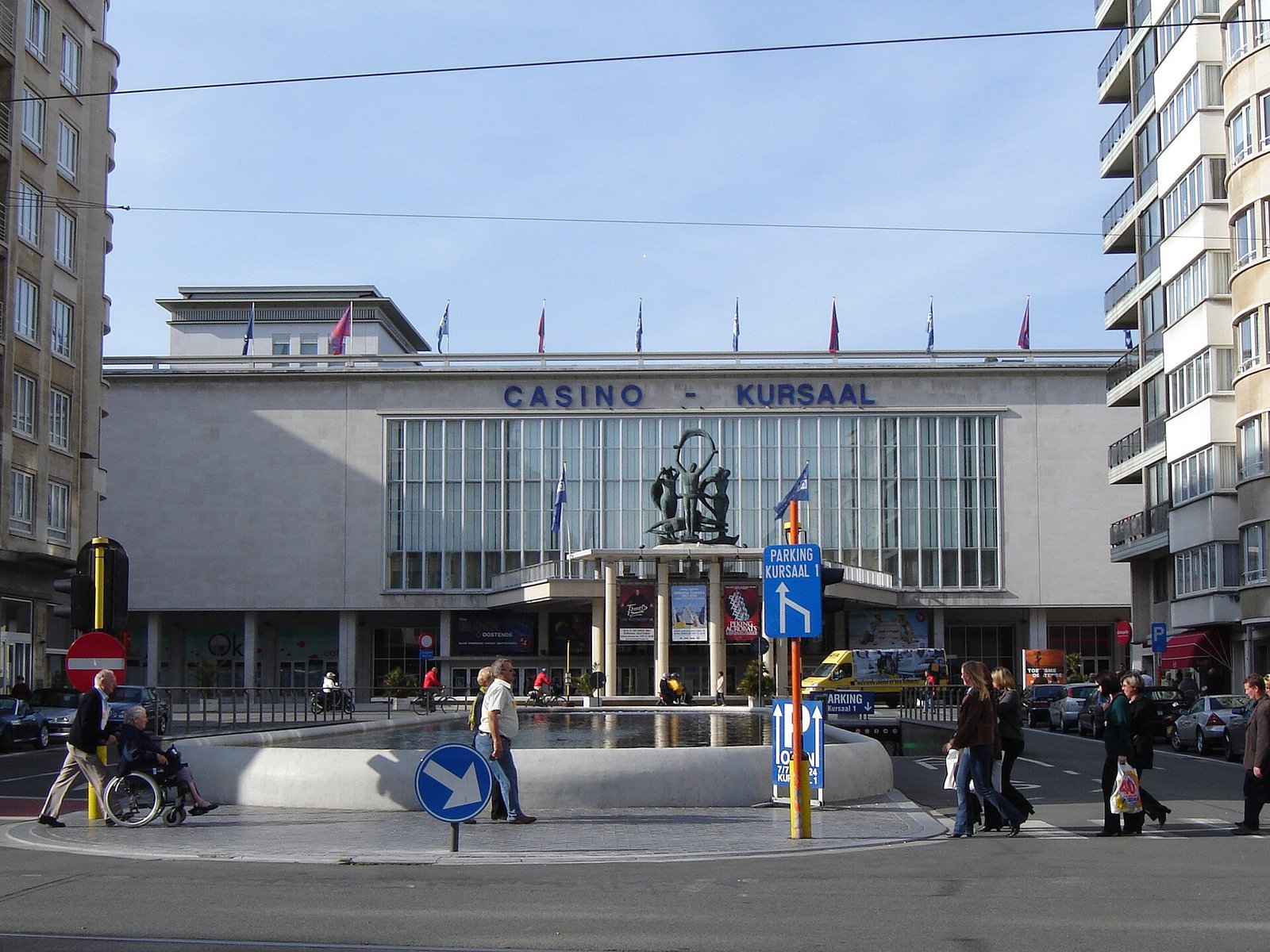
The Kursaal in Ostend, shown at the top of the page, is a seafront building that combines a casino with halls for shows and conferences. Many Belgian casinos work the same way: gaming is one activity among a restaurant, a bar and a programme of events.
The layout follows a fixed pattern. Reception comes first, where identity is checked, then a cloakroom and a cage where cash is exchanged for chips. Beyond them, the table games room and the slot machine room are often separate. Each table displays its minimum stake on a placard; the minimums by game are laid out in games and odds in Belgian casinos.
Age 21 and ID at the door
Physical gaming venues in Belgium admit nobody under 21. The threshold sits three years above the age of majority and above the 18 that applies to online play.
Identity is checked at reception whatever the visitor's apparent age. A valid identity document with a photo is required, such as the Belgian eID card or a passport. Without one, entry is refused.
| Venue | Licence class | Minimum age | Identity check |
|---|---|---|---|
| Land-based casino | A | 21 | Document at reception, EPIS consulted |
| Gaming hall (slot machines) | B | 21 | Document at the entrance, EPIS consulted |
| Online casino | A+ | 18 | Identity verified when the account is opened, EPIS consulted |
- Identity document shown at reception and age checked against the 21 threshold.
- Name checked against the EPIS register.
- Entry recorded in the visitor register.
- Coat and bag left in the cloakroom where the house requires it.
- Cash exchanged for chips at the cage, or directly at the table.
The EPIS register and self-exclusion
EPIS stands for Excluded Persons Information System. The Gaming Commission maintains it, and every licensed operator must consult it. A player listed in the register is refused entry to casinos and gaming halls and cannot open an account on a licensed online platform.
A player can register voluntarily through the Gaming Commission. The shortest voluntary exclusion lasts three months, and longer terms can be chosen at registration. One registration applies at once to every casino, gaming hall and online platform, so a single entry closes every door.
Casinos run the check at reception, online operators when a new account is created. Exclusion is a separate mechanism from the house's own right to refuse entry to anyone whose behaviour disturbs the gaming room.
Dress code and house etiquette
Each venue sets its own dress rule, displayed at reception. The common baseline is neat, everyday smart clothing. Photography and filming at the tables are restricted by house rules.
At a roulette table each player receives chips in a distinct colour, which lets the croupier assign winning bets. Chips stay on the layout until the croupier announces that betting is closed, and nobody touches them after that. A European wheel has 37 pockets, numbered 0 to 36; the arithmetic behind that single zero is set out in roulette odds and the 2.70% house edge.
Cash is never passed from hand to hand. The croupier takes banknotes from the layout and pushes the chips back. At blackjack, decisions are given by hand signal: a tap on the felt asks for a card, a flat wave of the hand means stand.
Online play: licence, Belgian domain, local payment rails
An online casino in Belgium operates under a Class A+ licence tied to a physical casino licence. The platform must be reached through a .be domain name, and a site without a .be address does not meet the licence condition.
Players must be 18 and register with a verified identity. The EPIS register is consulted at registration. The Gaming Commission publishes a list of licensed operators and a list of unlicensed gambling sites.
Payments run through Belgian banking channels: Bancontact, bank transfer and card schemes are the usual rails. Online slot machines publish a return-to-player percentage, a figure explained in slot machine RTP and cost per spin.
Winnings, tax and what stays in the player's pocket
A private player in Belgium pays no tax on casino winnings. A jackpot, a roulette win or a poker prize is not declared as income. Losses, in turn, are not deductible.
The tax falls on the operator, which pays gaming tax on its gross gaming revenue: stakes collected minus winnings paid out. That same difference measures the house's take. European roulette keeps 2.70% of all stakes over the long run, one thirty-seventh, and the figure for each game is listed in house edge by game.
Winnings in chips are exchanged for cash at the cage. The amount that reaches the player is the amount won, with no deduction at source.
Age limit, tax and licence types
Minimum age to enter a casino in Belgium?
The minimum age is 21 for land-based casinos and gaming halls, checked against a valid identity document at reception. Online casinos admit players from 18.
Are casino winnings taxed for Belgian players?
No. A private player pays no tax on casino winnings and cannot deduct losses. The operator pays gaming tax on its gross gaming revenue, meaning stakes collected minus winnings paid out.
Difference between a land-based and an online casino licence?
A Class A licence covers a physical casino at one address, with admission from 21. A Class A+ licence covers an online casino, can only be held by the holder of a land-based licence, requires a .be domain name and admits players from 18.